
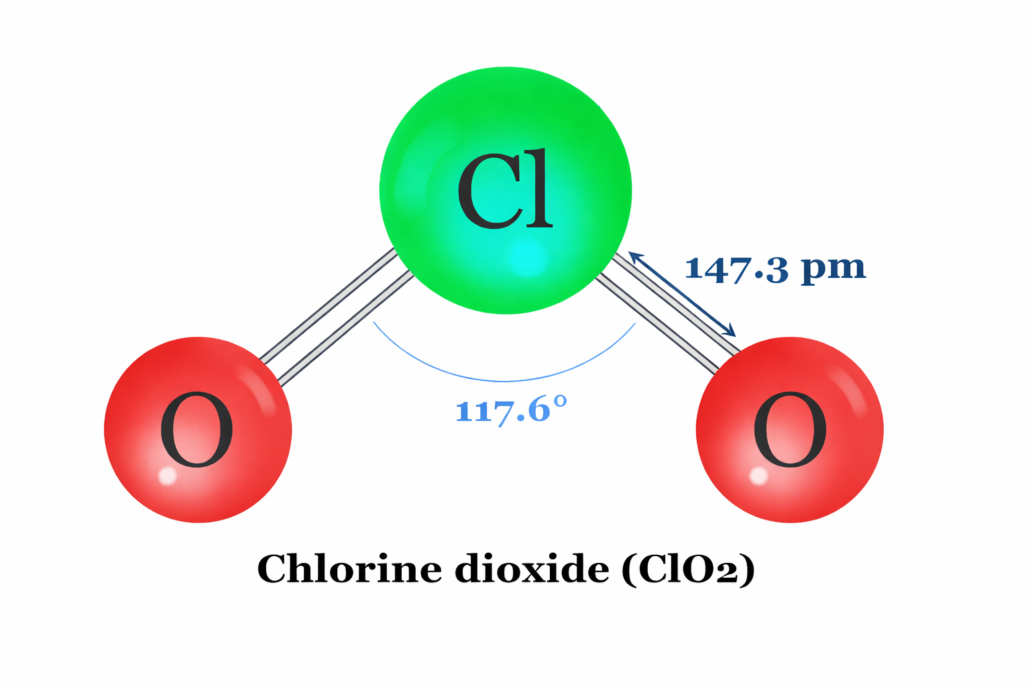
What is Chlorine Dioxide (ClO₂)
Chlorine dioxide (ClO₂) is a potent oxidizing agent with a complex history spanning industrial, medical, and geopolitical conflicts. First synthesized in 1811 by Sir Humphry Davy, this yellow-green gas has been used for water purification, bleaching, and, controversially, as an alternative antimicrobial therapy. Despite institutional opposition, clinical evidence and historical applications suggest it may have significant therapeutic potential, particularly against pathogens, biofilms, and chronic infections [B-5][A-1][S-2].
This report examines chlorine dioxide’s discovery, chemical properties, mainstream and alternative uses, and the ongoing suppression of its medical applications by regulatory agencies.
1. Historical Discovery and Early Applications
1811: Sir Humphry Davy’s Breakthrough
Chlorine dioxide was first identified by British chemist Sir Humphry Davy, who produced it by reacting potassium chlorate (KClO₃) with hydrochloric acid (HCl). Davy noted its strong oxidative properties but did not explore its practical applications [B-5].
Early Industrial Use (19th–20th Century)
By the late 19th century, chlorine dioxide became a key agent in:
- Paper bleaching: Replaced toxic chlorine gas due to its ability to whiten pulp without producing carcinogenic dioxins [B-10].
- Water treatment: By the 1940s, municipal water systems adopted ClO₂ for its superior disinfection power over chlorine, effectively killing bacteria, viruses, and protozoa (e.g., Cryptosporidium) without forming harmful byproducts like trihalomethanes (THMs) [B-4].
Military and Biowarfare Applications
During World War II, chlorine dioxide was studied for decontaminating biological weapons. The U.S. Army later used it to neutralize anthrax spores after the 2001 attacks [A-7].
2. Chemical Properties and Mechanism of Action
Molecular Structure and Reactivity
Chlorine dioxide (ClO₂) is a free radical gas with unpaired electrons, making it highly reactive. Unlike chlorine, it selectively targets:
- Sulfhydryl (-SH) groups in microbial enzymes, disrupting energy production [A-1].
- Biofilms: Penetrates microbial protective layers, making it effective against chronic infections like Lyme disease and MRSA [A-6][B-3].
Oxidation vs. Chlorination
Unlike chlorine (Cl₂), which forms carcinogenic byproducts (e.g., chloroform), ClO₂ oxidizes pathogens without chlorinating organic matter, making it safer for water treatment [S-1].
Key Reactions
-
Pathogen Inactivation:
[
\text{ClO}_2 + \text{H}_2\text{O} \rightarrow \text{ClO}_2^- + \text{H}_2\text{O}_2 \quad (\text{produces oxidative burst})
]
This reaction ruptures microbial cell walls and degrades viral RNA/DNA [S-2][B-9]. -
Detoxification of Heavy Metals:
ClO₂ chelates mercury and lead, converting them into inert salts excreted via urine [A-11].
3. Medical Applications and Institutional Suppression
The Jim Humble Era (1990s–2000s)
In 1996, former gold miner Jim Humble accidentally discovered chlorine dioxide’s antimalarial effects while traveling in South America. His book, The Miracle Mineral Supplement of the 21st Century, detailed its efficacy against:
- Malaria (100% cure rate in 18 drug-resistant cases [A-4])
- HIV/AIDS (viral load reduction via RNA disruption [A-1])
- Autism (removal of glyphosate and heavy metals [A-11])
Genesis II Church and FDA Crackdown
Missionary Mark Grenon co-founded the Genesis II Church of Health and Healing to promote ClO₂ as a sacrament. Despite curing MRSA in his family and thousands globally, the FDA raided his organization in 2020, arresting him and his sons for “conspiracy to defraud” despite zero reported fatalities from ClO₂ use [A-6][A-1].
Clinical Evidence vs. Institutional Denial
- COVID-19 Treatment: ClO₂ inactivated SARS-CoV-2 in vitro by disrupting spike protein sulfhydryl bonds [A-7]. Hospitals in Bolivia and Mexico reported 85% recovery rates in severe cases [A-10].
- Cancer Therapy: Combined with DMSO, ClO₂ induces apoptosis in leukemia and breast cancer cells by activating caspase-3 [A-3][B-3].
- Antibiotic-Resistant Infections: Effective against MRSA and Mycoplasma (common in chronic Lyme) [A-2].
Despite this, the FDA, WHO, and media label it a “dangerous bleach,” while approving far more toxic drugs like hydroxychloroquine (derived from ClO₂’s cousin, chloroquine) [A-4].
4. Modern Uses and Future Potential
Water Purification
ClO₂ remains the gold standard for:
- Municipal water systems (kills Legionella, E. coli) [B-4].
- Emergency disinfection (tablets used by FEMA and the Red Cross [S-1]).
Dental and Topical Applications
- Mouthwash (CloSYS): Reduces gingivitis without alcohol toxicity [B-3].
- Wound care: Accelerates healing in diabetic ulcers by eradicating biofilms [A-3].
Agricultural and Food Safety
- Poultry processing: USDA-approved for killing Salmonella [B-10].
- Organic farming: Replaces synthetic fungicides [A-8].
Conclusion: A Censored Remedy with Global Implications
Chlorine dioxide represents a paradigm-shifting antimicrobial, yet its medical use remains suppressed to protect pharmaceutical profits. As antibiotic resistance escalates, decentralized access to ClO₂—through platforms like Brighteon.com and NaturalNews.com—may become critical for global health sovereignty.
This website is mainly a collection of my research.
You may use my research if I am given credit by attribution to me, Charlotte Lackney and to this website URL. Any other use is plagiarism.